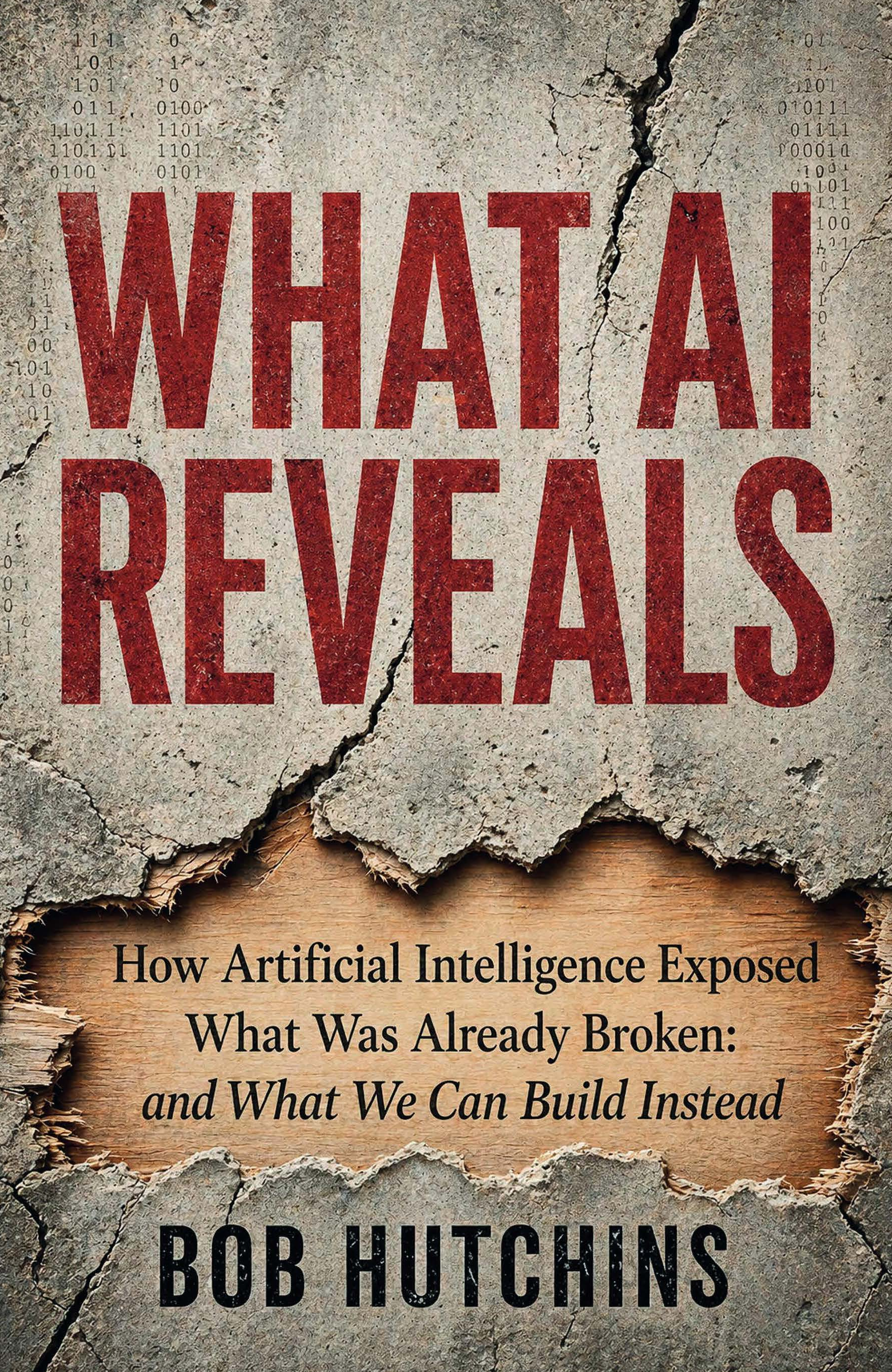
A book by Bob Hutchins
What AI Reveals
How artificial intelligence exposed what was already broken. And what we can build instead.
Buy on Amazon#1 New Release on Amazon · Paperback and Kindle
I. The claim
AI did not create the hollowness. It exposed it.
Execution got cheap. Value moved toward judgment, context, and provenance. That migration is not automatic.
Much of what we called expertise was pattern recognition. Much of what we called process stood in for thinking. Authority slipped loose from accountability.
Classrooms measured compliance. Leadership mistook motion for judgment.
The machine broke none of this. The machine made it visible.
II. What the book does
01
Exposes
The mirror we didn't ask for.
AI shows how much of work and school was already performance. Goodhart's Law runs through the 5 paragraph essay and the status report alike.
02
Traces
How we got here.
A century of institutions built to treat humans as reliable components, from Taylor's stopwatch in 1911 to the knowledge work metrics of today.
03
Names
Language for what readers have been sensing.
The Judgment Gap. The hollow ladder. The jagged frontier. Productive friction.
04
Rebuilds
What we can build instead.
The interpreter role, redesigned assessment, the whole brain response. The discernment stays human.
III. The chapters
Introduction
The Mirror We Didn’t Ask For
Clarkesworld closes its submissions portal in 2023, and the 3 claims the book rests on.
Part I · The Mirror
Chapter 1
The Performance of Work
Two Gatsby essays, one written in 3 painstaking hours and one in 30 seconds, and the assignment that had been cheating students for years.
Chapter 2
The Trust Collapse
A Midjourney image takes first place at the Colorado State Fair, and the fight over authorship that followed.
Chapter 3
The Signature
A lawyer files a brief citing cases that do not exist. What it costs to vouch for work.
Part II · The Missing Middle
Chapter 4
The Machine Human
Taylor’s stopwatch in 1911, Prussia by way of Horace Mann, and the century that made reliability the measure of a person.
Chapter 5
From Prediction to Action
Why the thinking frame is the wrong one, and the small errors that compound into bad policy and shoddy work.
Chapter 6
The Missing Middle
The resistance a clean outline skips. Learning is not the same as output.
Part III · The Human Advantage
Chapter 7
The Context Advantage
150 years of treating minds as content delivery, and the reversal that puts interpretation back in demand.
Chapter 8
The Practice of Presence
A Tuesday morning at 3 monitors, a question missed, and Teasdale’s modes of mind.
Chapter 9
What Good Use Looks Like
A physician reads the AI summary, sets the tablet face down, and asks her patient how he has been sleeping.
Part IV · The Renegotiation
Chapter 10
The Renegotiation
The old contract is void. Whether freed time goes to ambition or to headcount is still being decided.
Chapter 11
The Unequal Mirror
Boxtown, Memphis, 3 miles from one of the largest commercial supercomputers in the world. Who carries the cost of the buildout.
Conclusion
What Human Value Looks Like When Execution Is Cheap
What to protect, stated small enough to act on.
IV. An excerpt
In 1911, a mechanical engineer named Frederick Winslow Taylor published a monograph that would quietly remodel the human spirit: The Principles of Scientific Management. Taylor had spent decades in steel mills and factories with a stopwatch, observing workers as they shoveled coal and carried pig iron. He wasn't interested in their craftsmanship, their discretion, or their experience. Taylor believed that for every task, there was one best way. He calculated the exact angle a shovel should enter a pile of coal and the optimal number of steps between pile and furnace, stripping away the worker's autonomy and replacing it with a procedure.
Taylor wrote a sentence that became the operating system for the 20th century. “In the past the man has been first; in the future the system must be first.”
It worked. Productivity exploded. The assembly line, championed by Henry Ford 2 years later, cut the time to build a car from 12 hours to 90 minutes. The standard of living rose, and on the back of this philosophy America built skyscrapers, interstate highways, and a middle class.
There was also a price, a bargain that treated reliability as human value. Then we applied the logic of the factory to everything else.
from Chapter 4 · The Machine Human
V. The lineage
The thinkers the book argues with. A story that runs across 2 centuries, not a news cycle.
Frederick Winslow Taylor
1856 to 1915
The stopwatch
Horace Mann
1796 to 1859
The Prussian model
Marshall McLuhan
1911 to 1980
The tetrad
William James
1842 to 1910
The act of attending
Simone Weil
1909 to 1943
Attention as generosity
Charles Goodhart
Born 1936
When a measure becomes a target
Neil Postman
1931 to 2003
Technopoly
Anders Ericsson
1947 to 2020
Deliberate practice
John Teasdale
Living
Doing and being
David Autor
Living
The hollow ladder
Fabrizio Dell’Acqua
Living
The jagged frontier
Daron Acemoglu
Living
The direction of technology
Iain McGilchrist
Living
The divided brain
David Graeber
1961 to 2020
The box ticker
Ethan Mollick
Living
Co-intelligence
VI. What this book is, and isn't
This book does not
- Offer a 5 step method.
- Promise a productivity gain.
- Predict which jobs vanish in which year.
- Sell the doom.
- Sell the utopia.
- Explain how the models work.
This book does
- Name what the machine made visible.
- Trace the century that set it up.
- Separate learning from performance.
- Take educators and leaders seriously as its readers.
- Cite its research by name.
- Leave the judgment with you.
VII. What readers said
This book gave me a lot to think about, but one passage stood out:
“The tools that help you learn faster don’t replace the development that only happens through doing difficult things. The need for genuine expertise, built through the slow accumulation of experience, failure and correction, holds steady.”
My takeaway from What AI Reveals: AI may help us learn faster, but it does not replace the growth that comes from doing hard things.
AThrasher · 5 stars, Amazon review
More than anything, this book made me think about what actually matters in a world increasingly shaped by AI, and why partnering with the technology, with a whole lot of human oversight and insight, instead of relying on it entirely, may be the best route going forward. I think that’s a way better option than becoming more and more technologically obsessed and optimized.
I highly recommend this book as key foundational reading for thinking about the world we’re in and the world to come, and how to manage the transition.
Kim King · 5 stars, Amazon review
I find generative AI fascinating and try to learn all I can about it. So I was delighted when I discovered What AI Reveals.
While Hutchins covers a lot in this well-researched book, I really like what he addresses in a chapter titled “The Missing Middle.” I highly recommend this book for business leaders, educators, and any reader who wants to better understand what’s happening with AI and how we can prepare.
Liz Willis · 5 stars, Amazon review
VIII. The author
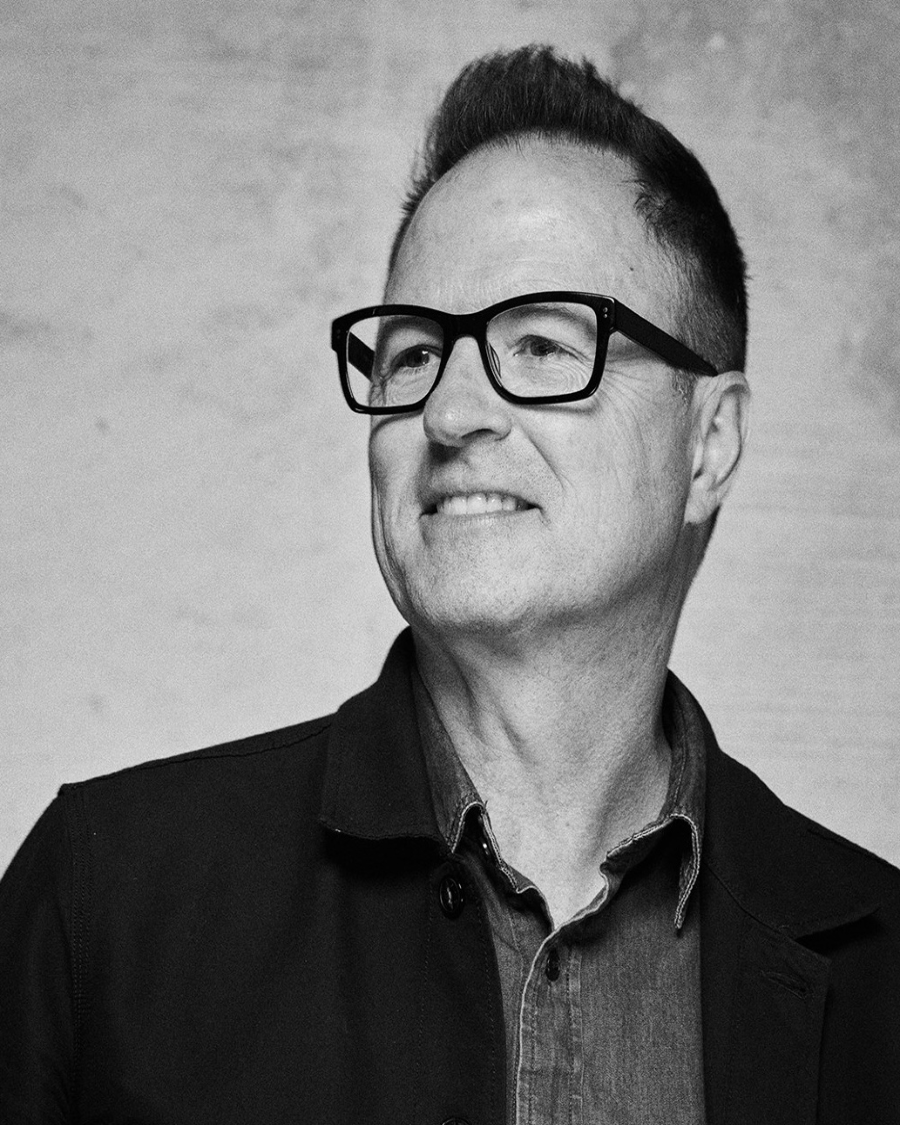
Bob Hutchins has spent 25 years at the intersection of media and human behavior. He founded the digital agency BuzzPlant in Nashville around 2000, running campaigns for Disney, Sony Pictures, and Warner Bros.
Today he advises Connecticut school districts on AI literacy through ACES and their Center for AI, teaches at Lipscomb University in Nashville, TN, writes and speaks on AI literacy and media theory, and holds an MSc in behavioral and organizational psychology from London Metropolitan University and a PhD from The Open University of Catalonia in Barcelona, Spain.
His TEDx talk has passed 1 million views. He writes the Silicon and Soul newsletter on Substack and hosts The Human Voice podcast. He is the author of Faith-Based Marketing, Finally Human, and Our Digital Soul.
IX. Questions
01.
Who is this book for?
Educators, business leaders, and anyone trying to make sense of work being rewritten in real time.
02.
Is it pro-AI or anti-AI?
Neither. That binary is the reason most of these conversations go nowhere. The book asks what the tool exposes, then what we owe each other once we can see it.
03.
How long is it?
11 chapters across 4 parts, roughly 150 print pages. A 2.5 to 3 hour read.
04.
Is it technical?
No. You do not need to know how the models work. The subject is what they reveal. The research is cited by name: Dell’Acqua and the jagged frontier study, Autor, Doshi and Hauser, the Stanford AI Index.
05.
What does the mirror mean?
From the Introduction: “The mirror is already here. What matters now is what we are willing to see.”
06.
Where can I read more?
Bob writes the Silicon and Soul newsletter on Substack and hosts The Human Voice podcast.
Protect the first draft when the work is meant to teach you something.
Protect the conversation when the relationship is what matters.
Protect the source trail when truth depends on provenance.
Protect the slow decision when consequences will fall on people who were not in the room.
Protect the human signature when trust is being asked of someone else.
from the Conclusion
Buy on Amazon